Advanced Certified ScrumMaster (A-CSM®) Certification

Ace the Advanced Certified ScrumMaster (A-CSM®) Certification Exam in the First Attempt in Just 4 Weeks
image

2.24,909+ enrolled

The CSM® certification or Certified Scrum Master certification is a globally recognized entry-level credential from the Scrum Alliance validating your Scrum expertise. Certnomics offers 16 hours of extensive CSM certification training led by Certified Scrum Trainers, covering Scrum Master certification curriculum essentials like core Scrum concepts, Scrum Values, Principles, Empiricism and Iteration and Incremental Delivery.

Want to Train Your Team? get a quote
450k

Career transformations

10 +

Workshops every month

100 +

Countries and counting

Course Highlights

  • CSM Training given by Certified Scrum Trainers(CST®) with 15+ years of experience
  • The CSM Certification grants 20 PDUs and 16 SEU®
  • 16 Hours Of Interactive Live CSM Certification Training
  • Industry Experts Designed Curriculum
  • 2-Year Membership With Scrum Alliance Included
  • CSM Exam Fee Is included In CSM Course Cost
  • Crack the CSM Exam on Your 1st Attempt
  • Engage In Interactive Doubt-Clearing Sessions
  • Access 24/7 Support And Learning Assistance
  • Unlimited Retake Training for 120 Days
  • Interview Preparation Toolkit for Scrum Master Roles
  • Get 2 Free Exam Attempts

Exam Format

  • Duration: 60 Minutes
  • 50 questions per exam
  • Number of Questions: 50
  • Question Type: Multiple-choice
  • Passing Score: 74%
  • Structure: Web-based, Open book exam
  • Scores are calculated only for correctly answered questions
  • Unanswered questions will be treated as incorrect
  • Exam will be submitted automatically when the timer expires
Advanced Certified ScrumMaster (A-CSM®) Certification Course Syllabus

Curriculum

Topic

  • Agile Manifesto
  • 12 Guidelines
  • Four values
  • 5 Scrum Values: the Scrum Foundations

Learning

  • Describe the Agile Manifesto’s 12 principles and 4 ideals
  • Show how “responding to change” in Agile is preferable than “following a plan” in conventional project management
  • Describe the connections between the Scrum artefacts, events, and roles and the Scrum values (courage, focus, commitment, respect, and openness)
  • TDescribe the connections between the Scrum artefacts, events, and roles and the Scrum values (courage, focus, commitment, respect, and openness)
  • The three Scrum pillars of Transparency, Inspection, and Adaptation should be listed and explained
  • Identify the distinctions between a framework and a methodology, and explain why Scrum is referred to as a framework
  • Describe 5 approaches to adopting an agile mentality
  • Give two examples of how Agile and Scrum differ from one another and why the two phrases should not be used interchangeably

Topic

  • Roles and difficulties of scrum masters
  • Obligations and tasks of the product owner
  • Roles and duties of the Development Team.

Learning

  • Make a list of three strategies to enhance performance and turnaround time.
  • Describe the duties that a Scrum Master and a Product Owner have.
  • Explain why the roles of a Scrum Master and a product owner should not overlap by listing three contrasts between them.
  • Talk about the role of the product owner as a bridge between the development team and the stakeholders.
  • Emphasise why a Scrum Master facilitates rather than actively participates in Scrum activities and ceremonies.
  • List three drawbacks of having a development team of fewer than three or more than ten people.

Topic

  • Planned a sprint.
  • Daily Scrum.
  • Reviewing Sprint.
  • Sprint Evaluation.

Learning

  • An explanation of sprint planning, daily scrum, sprint review, and retrospectives should be explained.
  • Recognize the rationale behind a sprint’s fixed scope and time limit.
  • Give three approaches to prevent spillover from the sprint backlog.
  • Discuss the five advantages of having a sprint objective and define sprint goals.
  • Recognise the manner in which the Product Owner and Scrum Master should coordinate with the team and provide five suggestions for enhancing these interactions.
  • Talk about the three negative effects of sprint cancellation and how to prevent it.
  • List 10 sprint anti-patterns and understand how they affect delivery and turnaround time (examples: sprint cancellation, variable sprint length).

Topic

  • Backlog for products.
  • Sprint Backlog
  • Practices of Lean Software Development
  • Increment in the Products

Learning

  • Examples of key characteristics of a well-formed product backlog, such as estimated and prioritized.
  • Talk about two duties that the development team, scrum master, and product owner have while building and maintaining a product backlog.
  • Purpose of having a product backlog and the best methods for refining the product backlog.
  • Discuss and analyze the optimal amount of time and resources to devote to refining the product backlog.
  • Showcase three activities that take place during a sprint review, such as the budget, timeline, and release plan.
  • List five anti-patterns for sprint reviews (such delayed acceptance) and their detrimental effects.

Topic

  • Planning for Sprint Execution
  • Management of flow
  • Resolution conferences
  • Communication (task board, story point-based sprint burndown chart, hours of effort)

Learning

  • Describe the differences between daily standups and resolution meetings.
  • Describe the advantages of working with product owners.
  • List 3 drawbacks of excessive product owner collaboration.
  • Give 3 examples of how to remove obstacles and work together.
  • Create a sprint burndown chart and demonstrate it.
  • Explain 3 methods the team can use to become more effective.

Topic

  • Maintain Daily Scrum Activity.
  • Sprint retrospective activities.

Learning

  • Describe the significance of the daily scrum meetings’ 15-minute time limit
  • Give three contrasts between daily stand-ups and typical meetings.
  • Describe the two roles that the Product Owner, Development team, and Scrum Master perform in daily scrum.
  • List two duties that the development team, product owner, and scrum master have at the sprint retrospective.

Topic

  • A feature’s (user narrative or product backlog item) definition of “Done”
  • Explanation of done for a sprint
  • Definition of done for a release
  • Defining done versus accepting standards
  • Done-Done vs Done

Learning

  • Describe the three stages of “definition of done”: user story (building code, for example), sprint, and release (creating release notes, for example).
  • Describe three advantages of the Definition of Done and why it can change over time.
  • Create a wish list for the DoD (with a minimum of 7 items).
  • Mention three dangers that a weak DoD poses.
  • List the top 5 qualities of effective acceptance criteria.
  • Recognise who should participate in creating the admission criteria.
  • List three consequences of not adhering to the acceptance criteria.

Topic

  • Explanation of Ready for user story
  • Get the definition of Ready for sprint

Learning

  • Make a comprehensive list of the Definition of Done.
  • List three consequences of a poorly constructed Definition of Done.
  • List at least three advantages of having a common Definition of Done for teams working on the same product backlog.
  • Give two suggestions for enhancing the term done.
  • Distinguish between “done” and “done done”.

Topic

  • About release planning
  • Those involved in the release planning
  • Releasing planned steps
  • Results of the Release Planning

Learning

  • Define and comprehend the release planning process.
  • Give three advantages of a well-planned release.
  • Describe three release planning outcomes.

Topic

  • Definition
  • Why and when to utilise a sprint burndown chart
  • data obtained from the sprint burndown chart.

Learning

  • Understand and define the sprint burndown chart.
  • Identify the top 3 uses for burndown charts.
  • Find out how to make a burndown chart and how to calculate it.
  • Describe the process for modifying upcoming sprints depending on the burndown.
  • List three important facts you learned from a burndown chart.
  • Give a burndown chart’s 5 benefits and 2 drawbacks.
  • Recognise the five typical mistakes that cause burndown charts to contain inaccurate information.

Topic

  • Definition of burn-up chart
  • Features about it
  • How to create a determined burn-up chart (steps)

Learning

  • Recognise the significance of having a release goal (based on prior experience and consensus).
  • Explain the significance of release burn-up in figuring out the situation as it is.
  • Compare and contrast burndown and burn-up charts in two ways.
  • Describe how to modify release planning, if necessary, in light of the fire down.
  • Give one main reason why a burnup chart is preferable than a burndown chart.

Topic

  • Recognise the significance of having a release goal (based on prior experience and consensus).
  • How to plan a product.
  • How to define product vision.
  • How to build a backlog for products.
  • A product roadmap.
  • Minimum Marketable Features, also known as Minimum Releasable Features.
  • Low-Risk Products.

Learning

  • Learnings about Product
  • Planning & implementation about product
  • RoadMap of the product

Topic

  • How do user stories work
  • User story elaboration and format
  • INVEST standards

Learning

  • Explain the definition of a user story, why it’s important, and how it fits into real-world initiatives.
  • Describe the three Cs of user stories.
  • Describe the significance of acceptance criteria and provide three possible outcomes when they are not satisfied.

Topic

  • Definition of Agile Estimation
  • Benefits of it.
  • Agile estimation Process.

Learning

  • Give five advantages of agile estimation, with examples.
  • Decide which of the seven widely used Agile estimating approaches is appropriate for your project by understanding them all.
  • Discuss three advantages of Planning Poker and Relative Estimation.
  • List three mistakes people often make while utilising relative estimation, along with their consequences.
  • Talk in depth about the five essential steps in planning poker.

A student can renew their certificate in the following ways:

A Recertification course is not as extensive as the Certification course and consists of only half the exam questions. A student can pass the Recertification exam with just a few hours of study. A student passing the Recertification exam implies that the student has reviewed the latest concepts from the SBOK™ Guide. As such, all previous certifications of the student get renewed for 3 years from the date of passing this certification exam.

A student passing any other SCRUMstudy™ certification exam implies that they has reviewed the latest concepts from the SBOK™ Guide and fulfils the criteria for maintaining certification.

Steps to Get CSM® Certification with Certnomics

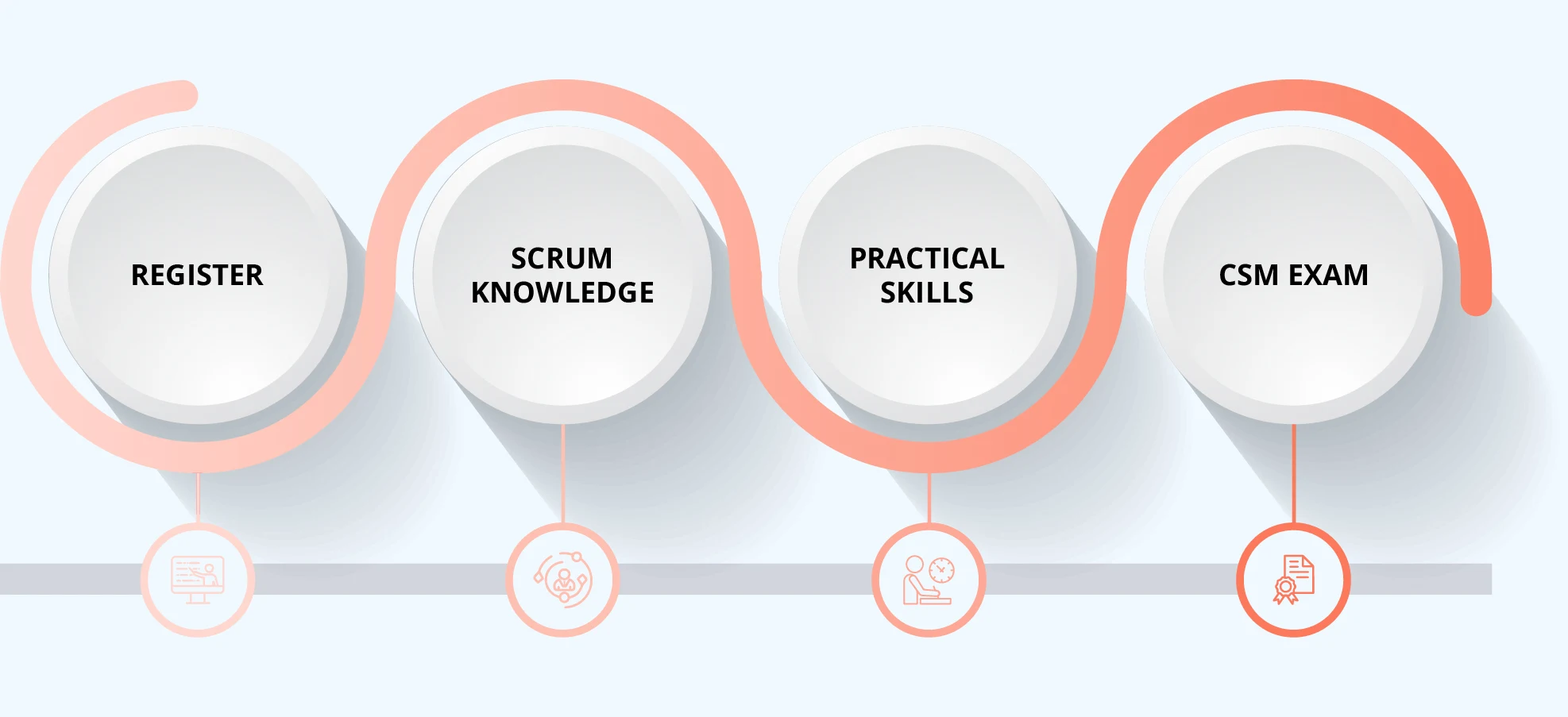
Though there is no mandatory prerequisite for most of the certification courses, it is always better to understand the hierarchy structure. The diagram below shows you what is the preferred as well as optional certification to move to the next level:

1.Register: Attend live Scrum training sessions provided by Certified Scrum Trainers from diverse industry verticals.
2.Scrum Knowledge: Acquire an in-depth knowledge of Scrum with the help of a curriculum designed by globally recognized Scrum experts.
3.Practical Skills: Gain hands-on experience by engaging in role-play exercises, Scrum activities, and real-life case studies.
4.CSM Exam: Appear for the CSM exam comprising 50 multiple-choice questions. You’ll have to obtain a score of at least 74% to pass the exam.

Next Cohort starts in 2 days

+1

By Signing up, you agree to our Terms & Conditions and our
Privacy and Policy

Talk to our advisor

Struggling to Find the
Perfect Schedule?

icon
View all Schedules

Explore our Corporate and In-House Training to upskill and reskill your teams.

skill up your teams

Explore our highly sought-after courses

Self Paced

Scaled Scrum Product Owner Certified

Course Validity: 180 Days

1,12,670+ Enrolled

Start from

Original price was: $500.00.Current price is: $450.00.

Explore
recommended

Self Paced

Advanced Certified ScrumMaster (A-CSM®) Certification Training

Course Validity: 180 Days

2,24,909+ Enrolled

Start from

Original price was: $225.00.Current price is: $175.00.

Explore
recommended

Self Paced

Scrum Fundamentals Certified

Course Validity: 180 Days

209,789+ Enrolled

Start from

$5.00

Explore
recommended

Got more questions? We've got answers.

Book a free Counselling Session today.